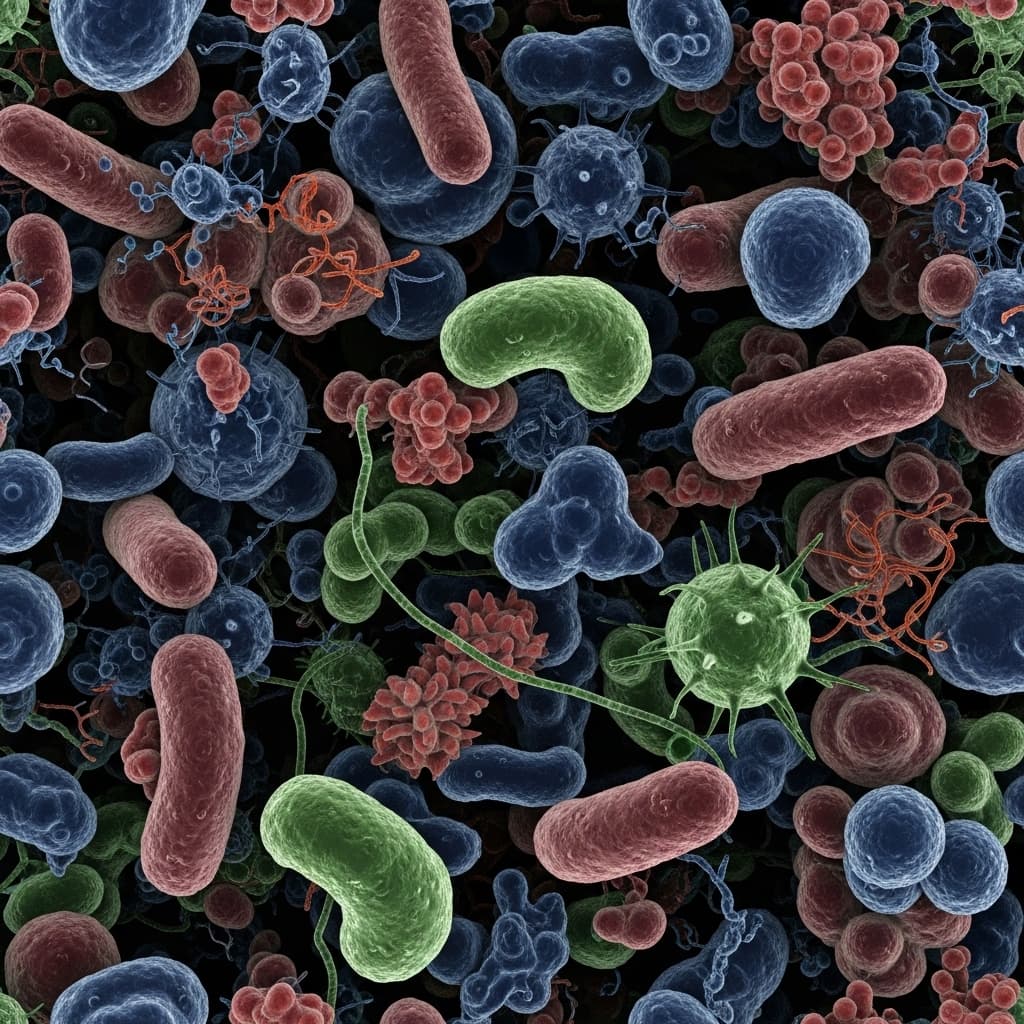
Why the Microbiome Matters
Right now, as you read this, approximately one million bacteria live on every square centimeter of your skin, outnumbering your own skin cells. For decades, we were taught that bacteria meant infection, that cleanliness meant elimination, and that healthy skin was sterile skin. We were wrong.
Your skin is not a barrier to be sterilized. It is a living ecosystem, as complex and interdependent as a rainforest, where invisible residents perform essential work every single day: manufacturing antimicrobial compounds, training your immune system, maintaining your skin's pH, and outcompeting potential pathogens before they can cause harm. This community of microorganisms, your skin microbiome, is as unique to you as your fingerprint, shaped by your genetics, your environment, where you live, what you touch, and how you care for your skin.
When this ecosystem is balanced, your skin glows. When it is disrupted by harsh cleansers, antibiotics, stress, or over-sanitization, the consequences show up as acne, eczema, rosacea, premature aging, and chronic irritation. In this article, you'll discover what the skin microbiome actually is, what it does for you, what throws it off balance, and why understanding this invisible ecosystem is the future of skincare. The science is clear: healthy skin isn't about killing bacteria. It's about cultivating the right ones.1
What Is the Skin Microbiome?
The skin microbiome refers to the diverse community of microorganisms (bacteria, fungi, viruses, and archaea) that colonize the surface and deeper layers of human skin. Unlike transient microbes that briefly land on your skin and wash away, the resident microbiome consists of stable communities that have co-evolved with us over millennia.1
The numbers are staggering. Conservative estimates suggest the skin harbors over 1 billion microorganisms per square centimeter in some areas, representing more than 1,000 different bacterial species alone.2 Add fungi, viruses (including bacteriophages that regulate bacterial populations), and mites, and you have an ecosystem of remarkable complexity living on an organ that covers roughly 1.8 square meters of your body.
This ecosystem is not uniform. Your forehead, armpits, forearms, and feet host radically different microbial communities, what microbiologists call "biogeography." Sebaceous (oily) sites like your face and upper back are dominated by lipophilic (oil-loving) bacteria such as Cutibacterium acnes (formerly Propionibacterium acnes).3 Moist areas like your armpits and groin favor Staphylococcus and Corynebacterium species.1 Dry areas such as your forearms show the highest diversity, hosting Staphylococcus, Micrococcus, and various environmental bacteria.1
Why does location matter? Because each niche provides different resources (sebum, sweat, nutrients, pH, oxygen levels) that select for specialized microbial communities. Your skin is not one ecosystem; it's dozens of interconnected microenvironments, each cultivating its own ecological balance.
What Does the Skin Microbiome Actually Do?
For most of human history, we viewed skin microbes as freeloaders at best and invaders at worst. Modern research has shattered that misconception. Your microbiome is an active, essential partner in skin health, performing functions your own cells cannot.
1. Protection Against Pathogens (Competitive Exclusion)
Resident microbes occupy physical space and consume nutrients that would otherwise be available to pathogenic invaders. Staphylococcus epidermidis, one of the most abundant skin bacteria, produces antimicrobial peptides that specifically inhibit Staphylococcus aureus, a pathogen implicated in eczema flares and skin infections.4 Think of it as territorial defense: when beneficial microbes are thriving, there's simply no room at the inn for harmful ones.
2. Immune System Education and Regulation
Your skin microbiome constantly communicates with immune cells in the epidermis and dermis, teaching your immune system to distinguish friend from foe. Research shows that commensal (beneficial) bacteria help calibrate immune responses, preventing both insufficient responses to true threats and overreactions that lead to inflammation and autoimmunity.5
Germ-free mice (raised without any microbiome) exhibit impaired immune development and increased susceptibility to inflammatory skin conditions.5 In humans, early-life microbial exposure shapes lifelong immune function, and disruptions during critical windows may increase risk for eczema and allergies.6
3. Skin Barrier Maintenance
The skin barrier, your outermost defense, depends on tightly organized layers of lipids and proteins. Several commensal bacteria enhance barrier function by promoting ceramide production, stimulating the expression of filaggrin (a key structural protein), and maintaining optimal skin pH (typically around 4.5 to 5.5).7 An acidic pH inhibits pathogen growth while supporting beneficial microbes, a delicate balance easily disrupted by alkaline soaps.
4. Anti-Inflammatory and Antioxidant Activity
Certain skin bacteria produce short-chain fatty acids and other metabolites with anti-inflammatory properties.8 Some strains even synthesize antioxidants that may protect against UV-induced damage and oxidative stress, potentially slowing visible signs of aging.8
What Disrupts the Skin Microbiome?
Microbial balance is fragile. Modern lifestyles introduce disruptions our ancestors never faced.
Over-Cleansing and Harsh Products
Frequent washing with harsh surfactants strips lipids, raises skin pH, and kills beneficial microbes indiscriminately. Studies show that even a single wash with antibacterial soap can alter microbial communities for hours to days.9 While hygiene matters, obsessive cleansing paradoxically increases infection risk by removing protective microbes.
Antibiotics (Topical and Systemic)
Antibiotics are lifesaving medicines, but they are blunt instruments. Topical antibiotics for acne and oral antibiotics for infections reduce bacterial diversity and can promote antibiotic-resistant strains.10 Overuse has long-term consequences for microbial resilience.
Diet and Metabolic Health
What you eat influences what lives on your skin. High-sugar, high-fat Western diets correlate with altered skin microbiomes and increased inflammatory skin conditions, though mechanisms remain under investigation.11 Emerging research links gut microbiome changes to skin health via the gut-skin axis, a bidirectional communication network.12
Environmental Factors
Pollution, UV radiation, climate, and even indoor living alter microbial communities. Urbanization associates with reduced microbial diversity compared to rural or natural environments, a pattern called the "biodiversity hypothesis."13
Psychological Stress
Chronic stress shifts immune function and sebum production, indirectly reshaping the microbiome. Stress-related skin flares in acne, eczema, and psoriasis may partly reflect microbiome dysbiosis.14
Why the Microbiome Matters for Skin Conditions
Understanding the microbiome reframes how we think about common skin disorders, not as simple infections or immune failures, but as ecological imbalances.
Acne
Acne isn't caused by C. acnes being present; it lives on everyone's skin. Instead, acne develops when specific strains proliferate in clogged pores, triggering inflammation.3 Recent genomic studies identified "bad" strains associated with acne and "good" strains linked to clear skin, opening doors for probiotic or strain-selective therapies.3
Eczema (Atopic Dermatitis)
Eczema correlates strongly with reduced microbial diversity and overgrowth of S. aureus during flares.15 Restoring balance through targeted antimicrobials, probiotics, or barrier repair can reduce severity and flare frequency.15
Rosacea
Rosacea patients show altered microbiomes and increased Demodex mites, though whether this is cause or consequence remains debated.16 Dysbiosis may amplify the inflammatory cascade driving redness and pustules.
Aging
Emerging evidence suggests microbial diversity declines with age, potentially contributing to skin thinning, dryness, and impaired barrier function.17 Maintaining a healthy microbiome may be a novel anti-aging strategy.
The Future of Skincare Is Microbial
For too long, skincare has waged war on bacteria. The future lies in cultivation, not elimination, nurturing beneficial microbes while discouraging harmful ones. This paradigm shift is already underway with the development of:
- Probiotics and postbiotics: live beneficial bacteria or their metabolites applied topically
- Prebiotics: nutrients that feed beneficial skin microbes
- Microbiome-friendly formulations: pH-balanced, gentle products that preserve microbial diversity
At its core, microbiome science teaches us humility. Your skin is not yours alone. It's a shared habitat, and the tenants are paying rent in protection, immunity, and barrier support. Treating them well means treating your skin well.
The invisible ecosystem on your skin is not optional. It's fundamental. And it's time we started caring for it accordingly.